Bachelor's thesis, Technical University of Denmark
Attention and stress, read from the body
- Biosignals
- Wearables
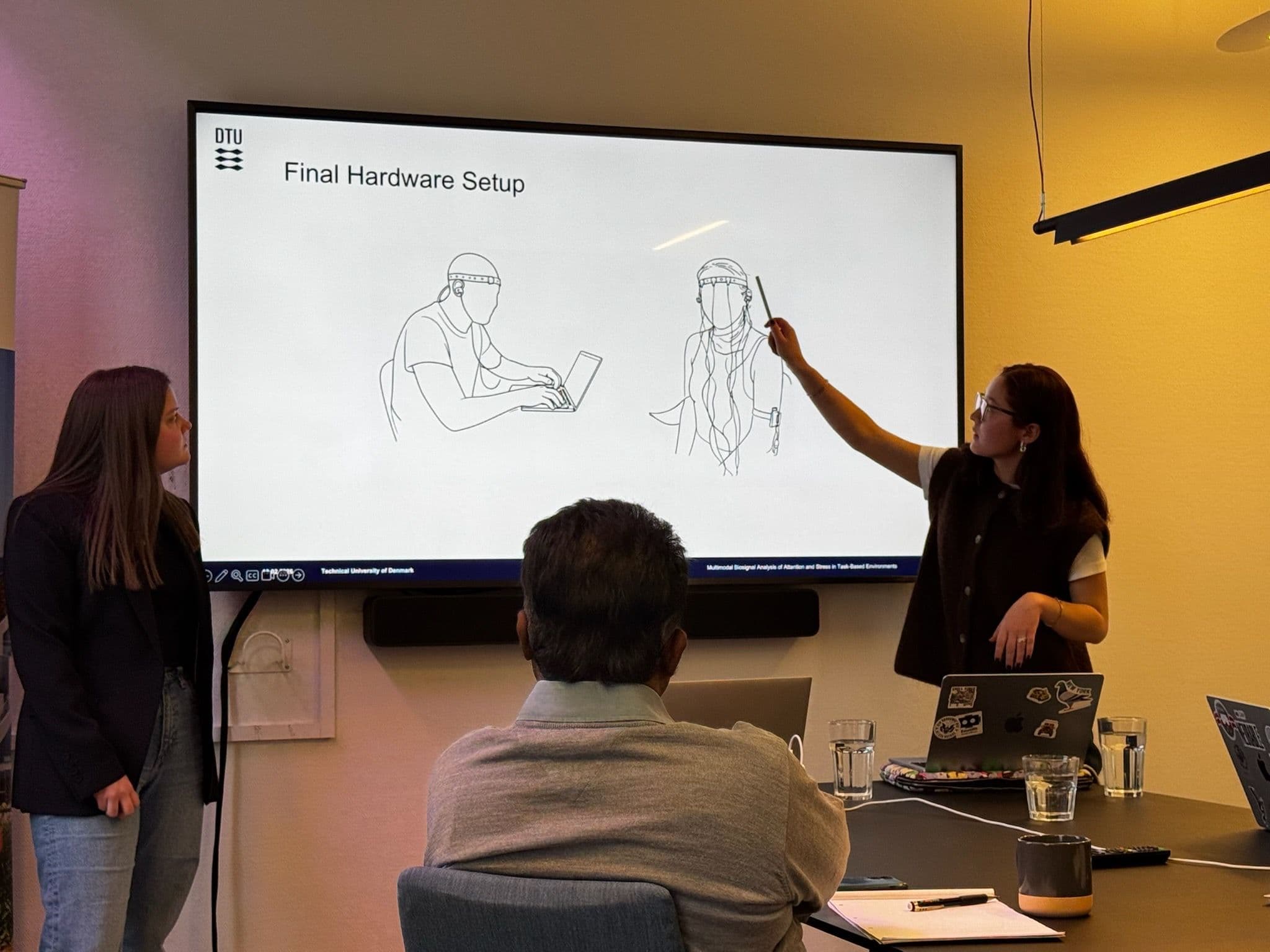
Three wearables on one person, synced to one clock. Brain signals tracked mental effort; heart and skin signals tracked bodily arousal.
The work
Attention and stress show up in the same tasks. A hard task usually asks for both, so neither one has a clean label. Most studies get around this by measuring a few signals and one state at a time, in a lab, with one kind of task. I couldn't find anyone who had checked whether a wearable could tell the two states apart.
Technical University of Denmark · Bachelor's thesis · 2026 · Grade 12/12
What I found
Attention and stress showed up in different signals. In the frontal EEG, every participant with usable data showed reduced alpha activity during mental math (p = 0.0007, corrected). Heart rate rose 7.9 bpm in that task, the only one with a significant rise, and holding your breath raised heart rate variability by 28.8 ms. Tonic skin conductance rose in every task, calm ones included, so it marked engagement rather than stress. A classifier trained on the same signals ranked heart and skin above EEG for stress, which points the same way, but with 13 to 16 usable people per task it was too small to test that gap.
What I did
- 01Found supervisors in Biomedical Signal Processing and Personalized Health Technology and co-designed an ethics-approved study.
- 02Ran 24 people through 9 tasks wearing an Emotiv MN8, an OpenBCI and an EmotiBit at once, synced through Lab Streaming Layer. One recording was unreadable, leaving 23.
- 03Tested every signal in every task with corrected statistics, then trained a classifier as a cross-check, always tested on a person it hadn't seen.
Results
- p = 0.0007: frontal alpha dropped during mental math, in every usable participant
- +7.9 bpm: heart rate during mental math, the only task with a significant rise
- 5 later theses reused the dataset
Per-task tests with false-discovery-rate correction; p values shown are corrected. The alpha result is relative alpha variability (IQR) at the frontal OpenBCI channel, n = 14 after quality control. Classifier: binary RBF-kernel SVM, leave-one-subject-out, balanced accuracy where chance is 0.5: HRV + EDA 0.60 ± 0.22, all signals 0.57 ± 0.22, EEG 0.53 ± 0.19 (SD across folds). About 13 to 16 people had usable data per task, so the classifier is exploratory. Stress labels come from the task type (mental math and Stroop vs reading and oddball).
related links.
- Thesis (PDF)
- Read the thesis